One journey of discovery · Scotland · Quebec · Michigan · Kansas City
The man who called himself Mike
A twelve-year search for my grandfather — and the three generations of reinvention behind him.
Beginning with what you're given
Every family search begins with what you're given. Here is what I was given:
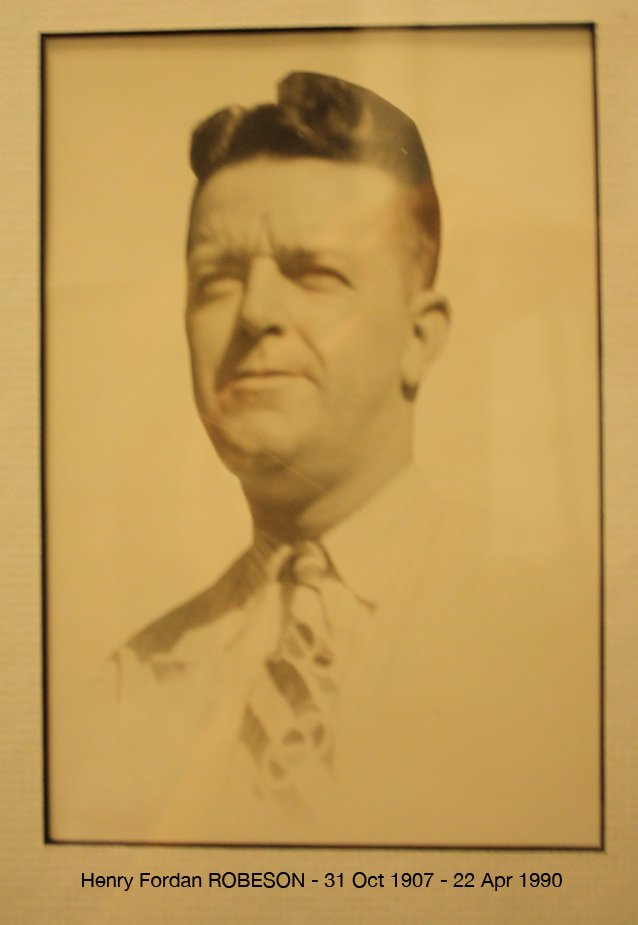
A name — Henry Michael Robeson, "Mike" to me, the grandfather I barely knew before he died in 1990. A birthday. A handful of stories he told my mother in his last years, after a veterans' hospital in California found her and ended an absence of nearly forty years. He'd been a gambler, he said, with winnings stashed in safe-deposit boxes around the country. He'd served in the Army in the war — true, though the tales he draped over it weren't. He could sing, and play piano. He said he'd been born on a train.
And one more fragment, from my grandmother — his ex-wife, who never spoke of him but would speak of his people: his father had been a traveling salesman who used to be a judge.
Almost everything on that list was wrong, embellished, or floating loose from any person I could find. Even the name. My grandfather was not Henry Michael Robeson. There was no Henry Michael Robeson. But I didn't know that yet.
The wall
I started where the facts touched ground: Kansas City, Missouri, where my grandparents married in 1931 and my mother was born. City directories, year by year. Census sheets. I found the family — Henry J. Robeson, salesman; Marie, his wife; three children, my grandfather "Harry" among them (no "Mike" anywhere — that name came later, another small self-invention). I found addresses that changed almost annually, a newspaper ad for a "Money Back Gas Saver," a mention of Henry J. as an invalid while his wife sold second-hand clothing.
And there it stopped. For years — and I mean years, this search ran across decades of my life — I could not get the Robesons out of Missouri. They appeared in Kansas City around 1908 as if they'd condensed out of the air. A salesman is a hard man to trace backward. He has no land, no practice, no parish. He has a suitcase.
What I had was that one strange, specific fragment: a salesman who used to be a judge. Salesmen are invisible. Judges are not. Judges get written down.
The first thread
My first break came when a contact I knew in Kansas City helped me look through the local newspaper's archived microfilm. After years of looking for a death record, I found it instead where this work so often hides its keys: in a death notice. Henry J. Robeson's 1937 obituary in The Kansas City Times, small and easy to pass over, named his survivors — and then, a name and a place: "a brother, William Robeson, Port Huron, Mich."
So I went looking for William — and William was everything his brother wasn't: findable. A chemist and inventor, well-documented, written up, papered. Census records held them both as boys in their father's household in Port Huron, St. Clair County, Michigan. William's passport application confirmed where he was born, in Canada.
Voilà! A new direction to follow. I'd made it as far as Michigan — so that's where I turned my sights.
The Rosetta stone record
In 1999 I was living in Los Angeles and working downtown, a few blocks from the central public library. I spent my lunch hours in the genealogy stacks. That's where I found it — call number GEN R 977.41 S13Hi — St. Clair County, Michigan, its history and its people, compiled by William Lee Jenks. The book was so old it was disintegrating in my hands. I photocopied the pages that August and transcribed them the following year, because I wasn't sure the book itself would survive to be consulted again.
Two passages, and the trail blew open.
The first profiled D. Robeson, ship chandler and dealer in vessel supplies — born 1825, "brought up in the city of Quebec," where he learned the business from his father, also a ship chandler. Came to Port Huron in 1868. Sail-making and the general outfit of vessels.
The second profiled Prof. Henry J. Robeson, Superintendent of Schools — born in the city of Quebec, April 20, 1853. Came to Port Huron with his parents in 1868, spent three years learning sail-making from his father, then the University of Michigan, then principal, then superintendent. Author of a book on parliamentary rules whose first edition "was exhausted within a fortnight." A large private library.
Two more generations, a migration path, a family trade, a city of origin — in an afternoon, on a lunch hour, in a book falling apart at the spine. Researchers dream about pages like these. I call them Rosetta stones: not because they answer everything, but because after them, everything else becomes translatable.
But a Rosetta stone written by men has men's vanities in it. The book said D. Robeson married Eliza Gregory and "they have five children — Henry J., William B., David M., Laura and Ethel." Tidy. And wrong. Those first three sons belonged to another woman entirely — a first wife, dead young, erased from the county history as if she'd never drawn breath. It would take a church register on another country's microfilm to give her back her name.
And the fragment my grandmother had carried anchored at last: professor, superintendent — and Justice of the Peace, his name on more than fifty Port Huron marriage records through the 1890s. A salesman who used to be a judge. That's something I've learned to tell people: family stories are rarely invented. More often they're unanchored — true things that drifted loose from their names and dates. You can disprove a lie. An unanchored truth you can only anchor.
A man in two halves
Here is why the wall had stood so long, and it's the part that still astonishes me: I hadn't been looking for a missing link between two men. I had been looking for one man who lived two lives.
The Port Huron half: professor, superintendent of schools for over a decade, author, attorney, Justice of the Peace, by one newspaper account mayor. A pillar. A man with a library.
The Kansas City half: traveling salesman, mining speculator, brewery clerk, seller of fifty-cent gas savers, invalid.
Between them, around 1900, at the age of forty-seven, Henry John Robeson simply stepped out of his own respectable life — left his wife of more than twenty years, chased gold in the Black Hills and zinc in Joplin, and started over with a woman twenty-five years his junior.
So follow the trail the way I actually found it: backwards. From a death notice in Kansas City, back through Joplin, through Detroit, through Port Huron — and further back than I ever expected to go.
May 1937
Kansas City · Floral Hills
Where the trail begins: a death notice
Henry J. Robeson dies at 84, with a small notice and a grave at Floral Hills — a different cemetery entirely from the wife he'd shared his second life with. Buried in the notice, unnoticed for decades, sat the thread that gave him back his first life: a brother in Port Huron.
December 1936
Kansas City · Calvary Cemetery
Six months earlier: Marie Theresa dies
Buried in consecrated Catholic ground, apart from Henry. Their separate resting places say out loud what a missing marriage record only whispers. Her story comes later — hold her name.
1931
Kansas City, Missouri
Harry marries
My grandparents, at the start. My mother would be born here in Kansas City. He was "Harry" in every record of these years — "Mike" hadn't been invented yet.
About 1908
Kansas City, Missouri
The Robesons condense out of the air
A salesman, his wife, and three children appear in the Kansas City directories — addresses changing almost annually, a fifty-cent "Money Back Gas Saver," no past attached. This is the wall, seen from the other side.
October 31, 1907
Probably Joplin, Missouri
Harry is born
No birth record exists — by choice, I believe. His middle name, Fordon, is his mother's maiden name carried forward. He would later say he was born on a train heading toward Kansas City; he wasn't, but Joplin really was a stop on his parents' drift. Even the fabrication leaned toward the truth.
About 1900
Detroit → the road
Henry John steps out of his life
At forty-seven, the superintendent, author, and Justice of the Peace walks out of respectability — the Black Hills for gold, Joplin for zinc — with a young woman he met in Detroit. Behind him in Michigan: a wife of more than twenty years who would call herself his widow for three decades while he lived on in Missouri.
1889
Port Huron, Michigan
The pillar of Port Huron
Superintendent of Schools for over a decade. Author of a book on parliamentary rules that sold out its first edition within a fortnight. His name on more than fifty marriage records as Justice of the Peace. This is the judge my grandmother's fragment remembered.
June 1880
Port Huron, Michigan
Henry and Agnes
A marriage of more than twenty years, childless, recorded in tidy census columns. And in the same city, the censuses held Henry and William as boys in their father's household — the brothers whose reunion in newsprint, fifty-seven years later, would crack this search open.
1868
Port Huron, Michigan
The family lands in Port Huron
David Robeson establishes the town's only ship chandlery — sails and the general outfit of vessels — and fifteen-year-old Henry John spends three years learning the family trade before choosing the university instead. But the Jenks book said this family was "brought up in the city of Quebec." The trail wasn't done running backwards.
Finding the family — Quebec, and then Aberdeen
Quebec meant church registers — and church registers meant microfilm from another country. That's where Ellen Martin got her name back: the St. Andrew's register recorded her marriage to David Robeson in 1852 and the baptism of their son Henry John the following spring. The county history had erased her; the parish had not. The Canadian censuses of 1842 and 1851 filled in the household around them — the sailmaking father, the Quebec shop, the family the Jenks book had only gestured at.
And then the registers pointed further back still — over the Atlantic, to Aberdeen, where every record in Canada agreed this family began. So I went looking for Robesons in the Scottish Old Parochial Registers.
There weren't any.
1882 · 1888
St. Catharines area, Ontario
The originators, at rest
The eldest David and his Mary, retired to Ontario, outliving nearly everyone. Whatever the clerks had done to their surname, their headstone got the last word about where they were from. It told me exactly where to look.
April 20, 1853
Quebec City
Henry John is born
Baptized at St. Andrew's, where his parents married. He sang in a boys' choir here — remember the music; it's the one inheritance that never got shed.
May 29, 1852
St. Andrew's, Quebec City
David marries Ellen Martin
The bride history tried to erase, restored by a church register on another country's microfilm. Her three sons — Henry J., William B., David M. — finally credited to the woman who bore them.
About 1832
Aberdeen → Quebec City
The crossing
In their late thirties, David and Mary uproot eight lives and sail for a country still being invented. Somewhere between the accent and the clerk's pen, something happens to the family name — but I didn't know that yet, standing at the registers with no Robesons in them.
December 1822
Old St. Pancras, London
A baptism under a third spelling
For years I couldn't find David Jr.'s birth record, and censuses kept insisting he'd been born in England. I dismissed it as enumerator error — until I stopped dismissing the records and started believing them. There he was: baptized in London, the family written down as ROBISON. The "error" had been the truth all along.
November 26, 1814
St. Nicholas, Aberdeen
The record that ended the search
What the Aberdeen registers held instead of Robesons was a marriage: David ROBERTSON, rope and sailmaker, to Mary Ronald. Wrong surname; right everything else.
The bride matched. The timing matched. And that occupation — rope and sailmaker — was the same distinctive trade the family carried through Quebec and Ontario and into Port Huron like a crest.
The name that wasn't the name
I remember sitting with that record, resisting it, testing it against everything I had, before I let the truth land: the surname itself was a derivative. My mother's maiden name — the name I had chased through four states and two countries — had never existed in Scotland. We were Robertsons. Somewhere in the crossing, the name transformed, and within a generation or two, no one remembered it had ever been anything else.
So how did Robertson become Robeson? My favorite theory needs no documents, only ears. Say "Robertson" the way Aberdeen says it — the r's rolled, the t softened nearly to nothing — to an English-speaking clerk on a Quebec dock in 1832, and listen to what he writes down. Robeson. It's possible the change was deliberate instead, a clean name for a new world; families did that. But that London "Robison" tells me the name was already drifting wherever the accent met a foreign pen. I don't believe anyone in my family changed our name. I believe it changed itself in other people's hearing — and the family simply stopped correcting it.
The London years hold one more mystery: the family's short stretch there was on business, I believe, likely tied to a silk merchant named Paul Tatlock — a connection close enough that David and Mary later named a son Paul Tatlock Robertson. Why give a business associate's full name to your child? I have theories — one already disproven — and one strange newspaper clipping about a woman who refused to be buried in Aberdeen. But that mystery deserves its own telling, another day.
Three generations, one pattern — and a surname to match. Robertson dissolves into Robeson at the water's edge. The professor becomes the salesman. Harry becomes Mike. My family didn't just migrate across an ocean and a continent. They migrated across identities.
Marie — her own story
And the woman Henry John started over with — she is her own story. Marie Theresa Fordon was the eighth and youngest child of a large Catholic farm family in Michigan's Thumb — a family devout enough that her father and uncles helped fund and build their parish church. Baptized Mary, she chose "Marie" for herself somewhere on the road that led away from Bingham. In this family, even the women renamed themselves.
She went to Detroit, apparently as a student, a small-town girl in the big city. And there she met a much older, married, childless man — and left with him.
Understand what that meant. A good Catholic daughter could not marry a divorced man; the Church would not have it, and I doubt her family would either. I believe that's exactly why some records that should exist, don't. There is no marriage record for Henry and Marie — anywhere, in over 30 years of looking, still to this day. There are no birth records for their three children, though Missouri's registration in those years is good; I believe the births happened at home, and unrecorded, by choice. Theirs was an unsanctioned life, and they kept it off the books. Absence, in a record set this well-covered, is not silence. It's testimony.
Marie apparently never gave up her faith. My grandmother converted when she married Harry; my mother and her brother were raised in the Church, and one of my cousins became a priest in St. Louis. And when Marie died in December 1936, she was buried in Calvary Cemetery — consecrated Catholic ground. Henry followed her in death just six months later and was buried somewhere else entirely, in Floral Hills. Whether he wouldn't join her or the Church wouldn't have him, I can't say. But their separate graves say out loud what the missing marriage record only whispers.
And their son Harry — my grandfather — inherited the family art. He shed "Harry" for "Mike," a name that appears in no record of his young life. He left his own family when his children were four and eleven. He said he was born on a train, heading toward Kansas City. He wasn't — he was almost certainly born in Joplin. But notice: Joplin really was a stop on his parents' drift from Detroit toward Kansas City. Even his fabrication leaned in the direction of the truth. He didn't lie about the journey. He just put himself in motion on it.
How I knew — and what "knowing" really means
Even with the thread in hand, no certificate ever announced this is the same man. What there was, was accumulation — an age that fit, an occupation that echoed the family fragment, a birthdate that matched, dots connected across over two decades until the weight of it left no other explanation standing.
That is what proof usually looks like in this work. A thread, and then a tide. If you take one thing from my story into your own search, take that. And take its companion: some pieces stay missing. I still have no marriage record, three missing births, no obituary for Marie. A family history isn't one with no gaps. It's one where the gaps can be looked at and bridged with reasonable assumptions.
The meaning — standing in it
In the summer of 2025, I finally went. Not to the records. To the places. Two voyages — first to Quebec, then to Aberdeen — and each one deserves its own telling.
Quebec City, in the rain. St. Andrew's Church — where David Robeson married Ellen Martin in 1852, where Henry John was baptized the following spring — was locked. I stood outside it and took photographs. Then I walked down toward the river, to the streets where the family first lived, land the sailmakers' generation had helped fill in from the mudflats. Their block is gone, built over. But the street names survive on lovely French plaques, some cobblestones survive, and a few streets over the houses still stand from the 1700s, so you can see the shape of the life. I was alone. I photographed a street sign and stood there doing the arithmetic: David and Mary were pushing forty when they uprooted eight lives and sailed to a country still being invented — and then lived more than fifty years in it. I smiled, standing in the rain, recognizing something. The exploration gene. The curiosity. The toughness. I know where mine come from now.
Weeks later, Aberdeen — this time not alone. My children and one of my grandchildren walked with me through Footdee, the little fishing village at the harbor mouth where the Robertson family lived on and off in the 1820–1830 timeframe before leaving for a new continent. Footdee, or ’Fittie’ as the locals call it, still exists. Its squares and cottages are still there. We wandered it together, three generations of us counting the one at my side, and the only word any of us reached for afterward was enchanted. I saw the church where David Robertson married Mary Ronald in 1814 — the marriage that started all of it — and stood outside trying to breathe in the ghosts.
The building being locked, the block being gone: none of it subtracted anything. Heritage travel doesn't promise the door opens. It promises you'll stand where it happened — and that standing there, something gets handed to you that no record can hold.
Coda
My mother is 88 this year. She learned each discovery as I made it. She's not much for the mystery or the psychology — those are my obsessions. What she loves is simpler and, I've come to think, just as true a way to hold an inheritance: she loves that she's Scottish, because she has the strawberry-blonde hair and the blue eyes to show for it. She loves that her grandfather was smart — a judge, an author. And she loves best of all that Henry John sang in a boys' choir in Quebec — because she is a soprano, because her father played piano and sang, because the one thing that passed intact through all those shed names and abandoned lives, from a choir loft in Quebec City through a gambler called Mike down to her, was the music.
Everyone takes what they need from the family story. Part of my work is finding all of it. The other part is honoring how much of it each person wants to hold.