One journey of discovery · Nashville · Tennessee · Kentucky · Colonial Virginia
Now we are Bennetts
What happens after the DNA surprise: meeting the family you never knew was yours.
A second inheritance
I've written before about the day the matches didn't match — when a dozen of us tested our DNA and my father's line, the Warners of Nashville, went silent in our results. The trail pointed instead to a man named William Bennett, husband of my great-grandmother's half-sister, and revealed that my grandfather Felix had been fathered outside his mother's marriage.
That piece was about the surprise. This one is about what comes after.
Because here is the strange arithmetic of a DNA discovery: you don't lose a family tree. You gain one. The Warner branches I grew up in are still mine — the stories, the cousins, the name I was born with. But grafted alongside them now stands an entire lineage that was always in our blood and never in our story. Seven generations of it, as it turns out, reaching back before America was America.
So I did what I do. I went and met them.
William, the huckster
Start with the man himself. William Edgar Bennett was born in October 1884 in Sumner County, Tennessee, a farmer's youngest son. By his twenties he'd come into Nashville, and the city directories track him year by year through the honest, unglamorous occupations of a working man: laborer, driver, clerk, and finally — the word I've come to love — huckster. Not the modern insult; the old trade. A huckster drove a wagon through the neighborhoods selling produce, calling his wares. That was Felix's biological father: a man selling vegetables from a cart on the streets of Nashville.
His World War I draft card even tells me what he looked like. Tall. Slender. Brown eyes, light hair. I confess I've pulled out photographs of my grandfather and studied them differently since.
The records also quietly corroborate the how of it all. In April 1910, the census taker found William and his wife Katie living in Sumner County in the very next household to Katie's father, Thomas Raymer — the same farm my great-grandmother Jessie regularly visited. By the 1911 directory, William and Katie had moved into Nashville, near the Warner household. My grandfather was born in June 1911. I don't need to spell out the geometry; the census and the calendar do it for me.
I want to be careful with William, though, because it would be easy to cast him as just the other man — and his own life gives me no appetite for that. Katie died young, only thirty. William was left a widower with four children, the youngest still small. He remarried late, in his mid-forties, had three more children — and buried one of them, a twin daughter, as a toddler. Then he died himself at fifty. Whatever he was to Jessie in 1910, the fuller record shows a man who hauled a hard life a long way. In my family we have a saying now, learned the slow way: nobody in the tree is a villain or a saint. They're all just people, caught in their moment.
From William, the trail runs back through Middle Tennessee like a wagon road. Follow it the way I walked it: backward.
June 1911
Nashville, Tennessee
Felix is born
My grandfather — raised a Warner, a Bennett in his blood, and never once told. His mother's story is its own journey.
April 1910
Sumner County, Tennessee
The geometry
The census taker finds William and Katie in the very next household to Katie's father, Thomas Raymer — the farm Jessie regularly visited. By the 1911 directory they've moved into Nashville, near the Warner household. The census and the calendar spell the rest.
October 1884
Sumner County, Tennessee
William Edgar Bennett is born
A farmer's youngest son. The Nashville directories will track him through laborer, driver, clerk, and at last huckster — a man selling vegetables from a wagon, calling his wares.
1876
Sumner County, Tennessee
George Washington Bennett marries Bettie Smith
William's father — except when he was G.W., except when, on one census, he decided he was "James." A farmer who worked the land until he slipped out of the records sometime after 1900, leaving no death record and no found grave.
About 1815
The Tennessee–Kentucky line
Richard Bennett is born
George's father spent his whole life shuttling across the state line — farmer in Robertson County, miller a decade later, then Simpson County, Kentucky, then back to Sumner — the border apparently more of a suggestion than a boundary. Two wives, fifteen known children, and, like his son, no grave anyone has found.
About 1811
Virginia → Sumner County, Tennessee
Griffin Bennett comes out of Virginia
The tax lists record Griffin, over a dozen years, under five spellings, at the mercy of whichever clerk held the pen. Phonetic spelling like this is neither surprising nor unusual — it has been around forever, and it is a researcher's trial. Spelling was fluid because there were no rules and no readily available dictionaries; a name was written the way it sounded to the person holding the pen. If you want to find your people, you have to think about how the name would have sounded — and search every version. This family's surname alone appears as Bennet, Bennett, Bennitt, Bennatt, and more. (Robertson-to-Robeson, on my mother's side, is the same lesson.)
And why did he leave Virginia at all? The deeds gave me the answer: his wife Kitturah's people, the Stones, were moving to Tennessee, and Griffin and Kitturah went with her family. Some migrations are epics. Some mean you follow your in-laws.
The soldier
Griffin's father was a mystery and complexity to untangle. While he is named in the 1832 Will of his father Richard Bennett Sr., there was more than one man of that name in the Virginia counties where they originated.
Discovering a pension application that identified Richard Sr. pulled the family back in time to before the Revolutionary War.
Richard Bennett was born about 1758 in colonial Virginia. In 1776 — a teenager, in the first year of the war — he enlisted in the 7th Virginia Regiment of the Continental Army. The muster rolls carry him through the Battle of Brandywine and the Battle of Germantown, and his regiment wintered at Valley Forge. He served out his enlistment, went home to Amelia County, and enlisted again.
Through my grandfather's hidden paternity, it turns out my father's line runs directly to a soldier of the American Revolution. He's not the first one, but he was hidden. My father's mother comes from a long line of original colonists, many who served in that War of Independence, and got land grants in Tennessee as payment.
But where I'd grown up with stories of a German immigrant who fled the European wars between principalities and met his wife onboard the ship crossing the Atlantic before settling in Nashville to raise a large brood of Catholic Germans who became butchers by trade, I now had a whole new history to absorb. Some of it fascinating. Some of it uncomfortable.
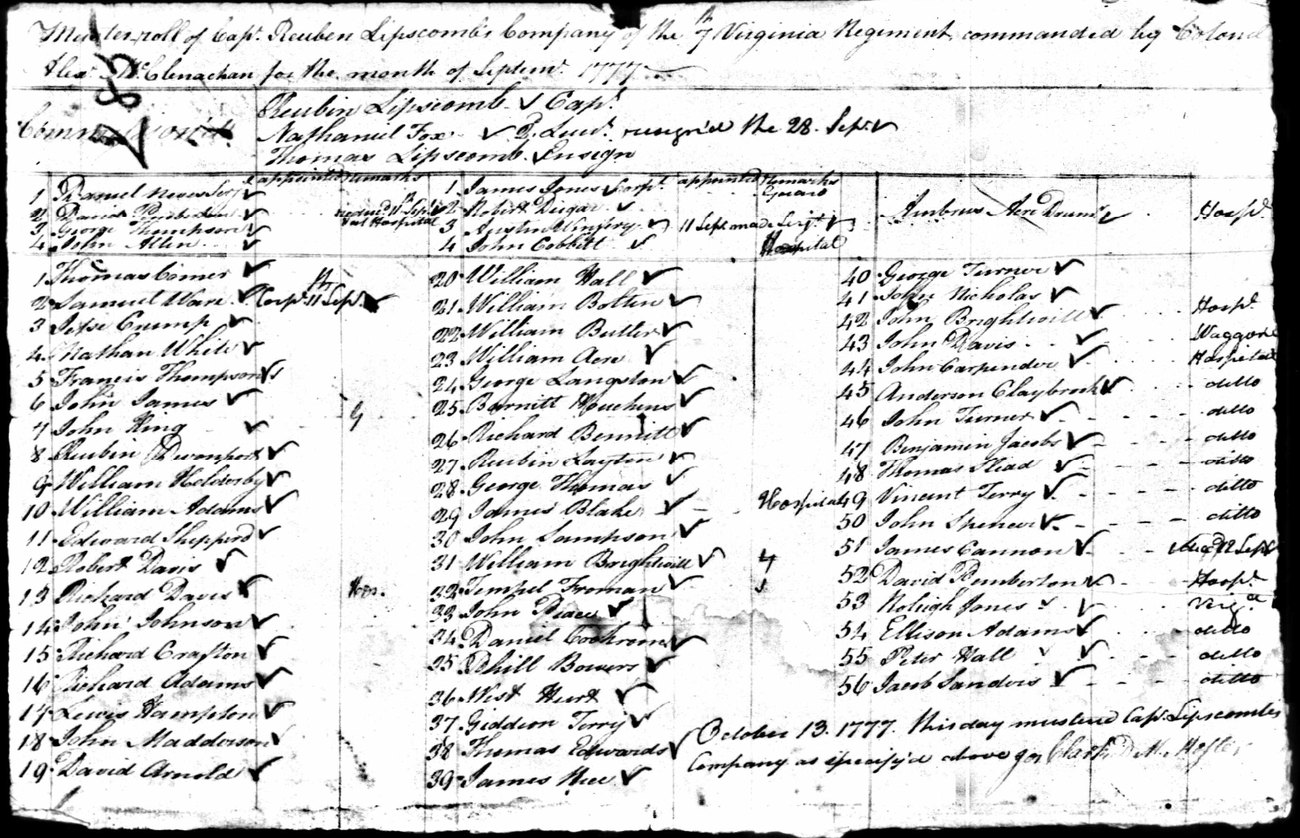
September 1777
7th Virginia Regiment
Richard Bennitt, present
Captain Reuben Lipscomb's Company — mustered October 13, 1777, weeks after Brandywine, days before the winter that would be Valley Forge. Nineteen years old, give or take, and checked present.
June 10, 1812
King William County, Virginia
The conveyance that cements the chain
Twenty years before his death, another Rosetta stone: Richard Bennett "and Chrischaney his wife" — Christianna Waller, named a Bennett in her father Major Waller's 1793 will — join his brother Walker and sister Mary in selling the 125-acre plantation "whereon the sd Samuel Bennett dec'd lived," as the joint heirs of Samuel Bennett, late of King William County. The deed even reaches a generation further back, reciting the original 1739 conveyance to an earlier Richard Bennett. One document, and the whole chain locks: Samuel's son, Griffin's father, Christianna's husband. That spring the Richmond Enquirer had run two months of legal notices naming Samuel executor of Richard dec'd — the generations stacked in the record like strata.
September 1832
Sixteen days
He tells his story, and then he goes
On September 1, 1832, aged seventy-four, Richard executed his Revolutionary War pension application — the sworn account of his service, Brandywine and Germantown and all, that survives in his file to this day. He died on September 17, 1832.
Sixteen days. He told his story, under oath, for the record — and then he was gone. If there is a better argument anywhere for writing family stories down now, I have never found it. His will gave his son Griffin $400 and not an acre — and a decade-wide age gap in the children hints Griffin was the child of an earlier marriage, a suspicion DNA is now quietly supporting. Even inside the "new" line, there are older secrets waiting.
November 14, 1832
Jeffrey's Store P.O., Virginia
The certificate arrives after him
On November 14, 1832 — fifty-eight days after Richard's death — the certificate of pension was issued and mailed to Jeffrey's Store P.O. He told his story sixteen days before the end. The country's answer never reached him.
The hard page
I promised when I started this work that I would tell the whole of what I find, and this line holds a page I won't turn past.
Richard's father, Samuel Bennett, held a 125-acre plantation in King William County, Virginia. And in the county court records of 1811, there is a conveyance in which Samuel transfers property: one sorrel mare with a star on her forehead, one cow — and two human beings. One negro man named Moss. One negro woman named Cat.
I believe we can honor all our ancestors without endorsing everything they did — that honoring is not approving. We can also be clear-eyed and refuse to look away. Moss and Cat were held in bondage by my ancestors, and the record that helps prove my descent is the same record that documents their enslavement. I can't repair that from here. What I can do is decline to let them disappear a second time — into the silence of an untold family history.
Will the real Richard Bennett please stand up.
There were at least three Richard Bennetts in the same Virginia counties at the same time — and even more once the Juniors started showing up. Telling mine apart from the others is why I went laboriously through years and years of tax records and court files, tracing where each man moved — and, as uncomfortable as it was, tracing the enslaved: which people were named in one Bennett's will, and might then be enumerated in another Bennett's files. It is heartbreaking work, and nothing in it is to be condoned or taken pride in. These men went along with what was accepted in their time, and the records are the terrible proof.
Richard — the soldier, the pensioner — enslaved people as his father Samuel before him. His 1832 will bequeaths eight by name. The estate inventory taken that November lists twenty-four: Aggy. Armstead. Asa. Frances. Hannah, and her child Edward. Harriett. James. Jane. John. Jordan. Lucy, and her child Roscoe. Luther. Martha. Messy. Milly. Narcissus. Ned. Paul. Peter. Pherebee, and her child Manirva. Silas.
The reason to include this and say these names is the only good one: somewhere, someone may be searching for their own ancestors through the fog of their enslavers' paperwork. If Aggy, or Armstead, or Pherebee and her child Manirva — or Moss, or Cat — appear in that person's search, then these terrible records become a door. That is the reason to disclose them. They were part of my family's story. So they are in it.
I have more work to do to uncover where Samuel Bennett came from. Likely the son of yet another Richard. But that's what makes this work so fascinating. It's a puzzle that is never truly solved.
Grafted, not pruned
So: now we are Bennetts. Also. Still Warners — in name, in upbringing, in the hundred cousins and the handed-down stories, in everything that actually raised us. But in blood we run back through a Nashville huckster's wagon, through Tennessee farm dirt and a Kentucky mill, through a teenager at Valley Forge, through a plantation's terrible ledger, deep into colonial Virginia.
My grandfather Felix lived his whole life and never knew any of it. It was there the entire time — in his tall frame, maybe; in his blood, certainly — waiting a century for a handful of cousins to spit in tubes.
That's what a DNA surprise really offers, once the shock settles. Not a replacement story. A second inheritance. The tree doesn't get pruned. It gets grafted — and it bears stranger, richer fruit than the one you thought you were standing under.