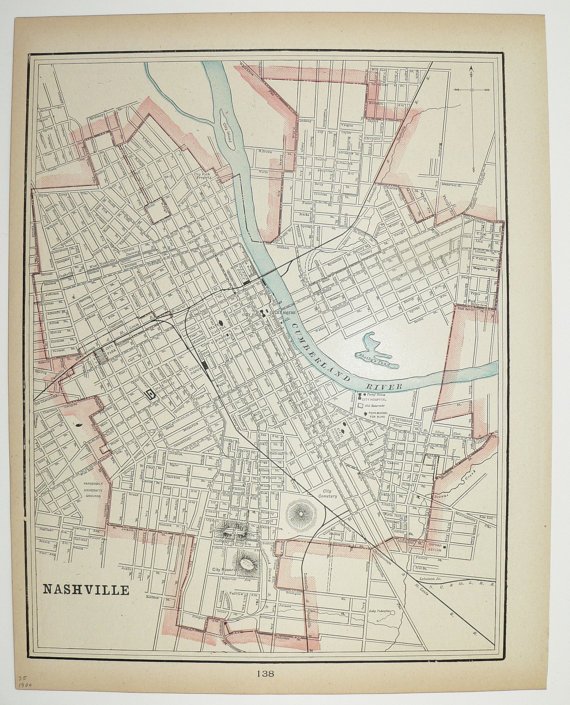
One journey of discovery · Nashville, Tennessee
The secrets Jessie kept
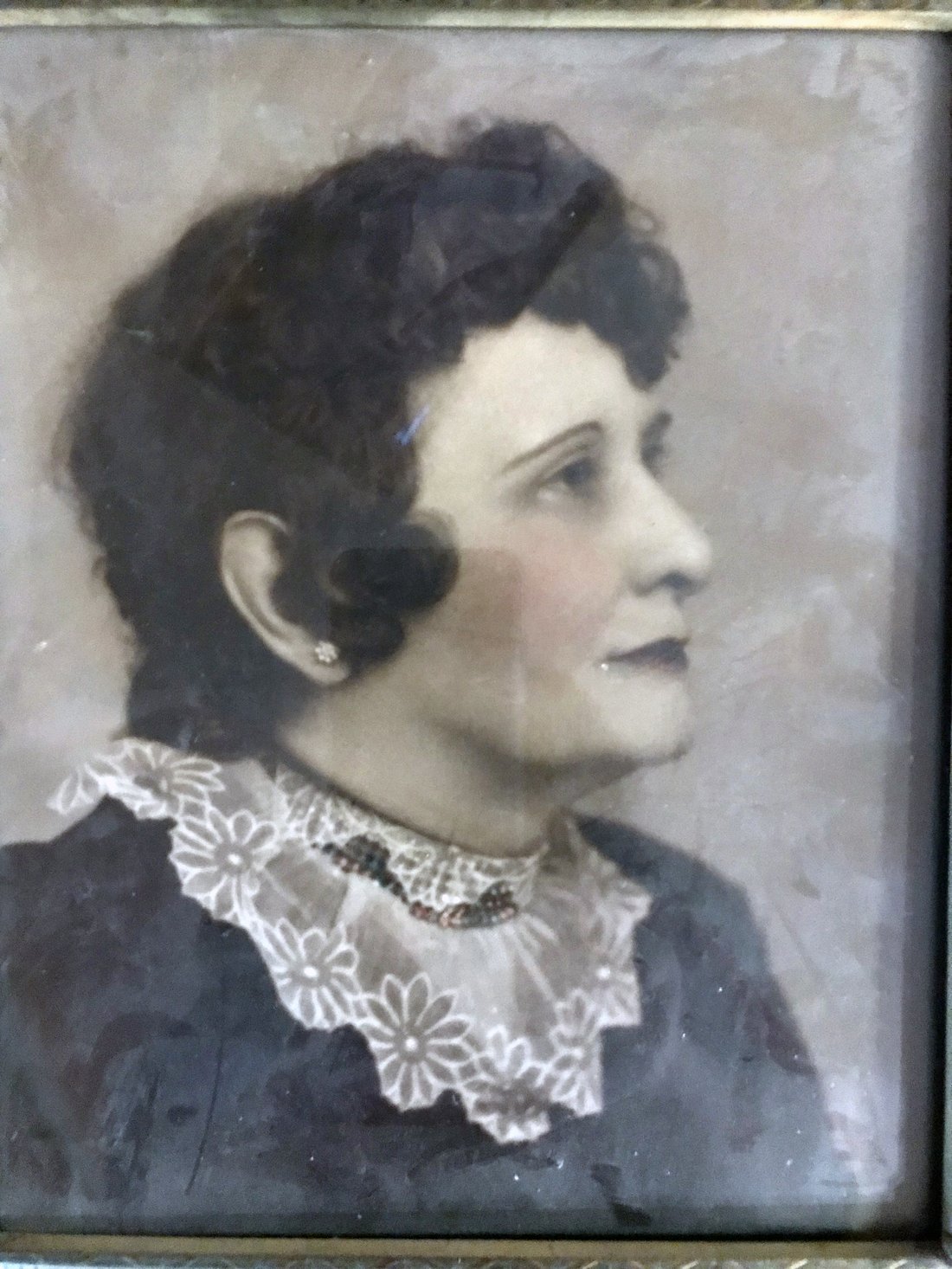
She was a third-generation Tennessee native, part of the Nashville social scene. She was, by every telling, the heart of her family — and for over a hundred years, a key part of her story stayed hidden in plain sight.
Beginning with questions
Let me tell you about my great-grandmother.
Jessie Byrd Raymer was eleven months old when her mother died. Her father, Thomas Langford Raymer Sr., was left with a baby girl and four young sons, and he did what widowed men of his era so often did: he remarried within the year. Two years later, the family absorbed another blow that is almost unthinkable now — one of Jessie’s brothers, just twelve years old, was kidnapped and murdered.
Grief kept its seat at the Raymer table. Thomas and his new wife lost their first two children together. Four more followed, and three of them survived. His second wife was a woman of unusual enterprise for her time: she owned a saloon in Nashville, and a grocery besides. Jessie grew up amid the noise and commerce of that saloon, with a father who drank heavily and a household that had learned, over and over, how to carry loss.
When Jessie was seven, her half-sister Katie Ilene was born. Remember Katie. She matters.
At eighteen, Jessie married James Henry Warner, a man nearly a decade her senior from one of Nashville’s well-known families of German butchers. James was, by every account, a formidable presence — the Nashville Banner reported his weight at over three hundred pounds. He had been married once before, without children; the public divorce record shows his first wife cited cruelty, and James, a Catholic, later had the marriage annulled. Jessie herself would eventually file for divorce on similar grounds — and then withdraw the petition. Whatever passed inside the walls of the Warner household, the paper trail suggests it was not a gentle place.
August 23, 1881
Tennessee
Born
Jessie Byrd Raymer is born in Tennessee — a daughter after four sons, and motherless before her first birthday.
January 8, 1898
Nashville
The East End Lucky Club
Sixteen, and already a hostess: the club meets at her home at 402 Shelby Avenue and indulges in “various games until a late hour, when dainty refreshments were served.” Before she was a Warner, she was a girl the papers knew.
December 14, 1898
Nashville
White roses and ferns
Seventeen, sociable, and present — a birthday party “decorated in white roses and ferns,” her name in the guest list beside friends and neighbors. This is the Jessie before the Warner years: young and out in the world.
May 1899
Nashville
A license is issued
Two lines in a newspaper column: J. H. S. Warner and Jessie B. Raymer. He is a decade her senior, from a well-known family of Nashville’s German butchers, once married and annulled. She is seventeen.
June 1900
Nashville, Ward 9
The census finds them
James H. Warner, bill clerk, and Jessie B., wife, married one year. A tidy line in a ledger. The paper trail suggests the household was anything but gentle.
October 7, 1903
Circuit Court, Nashville
Four lines in a noisy page
This is what discovery feels like. An entire day’s world — a murder trial, a Sunday lesson, the Syrup of Figs company — and buried in a middle column, four lines that change a family’s story.
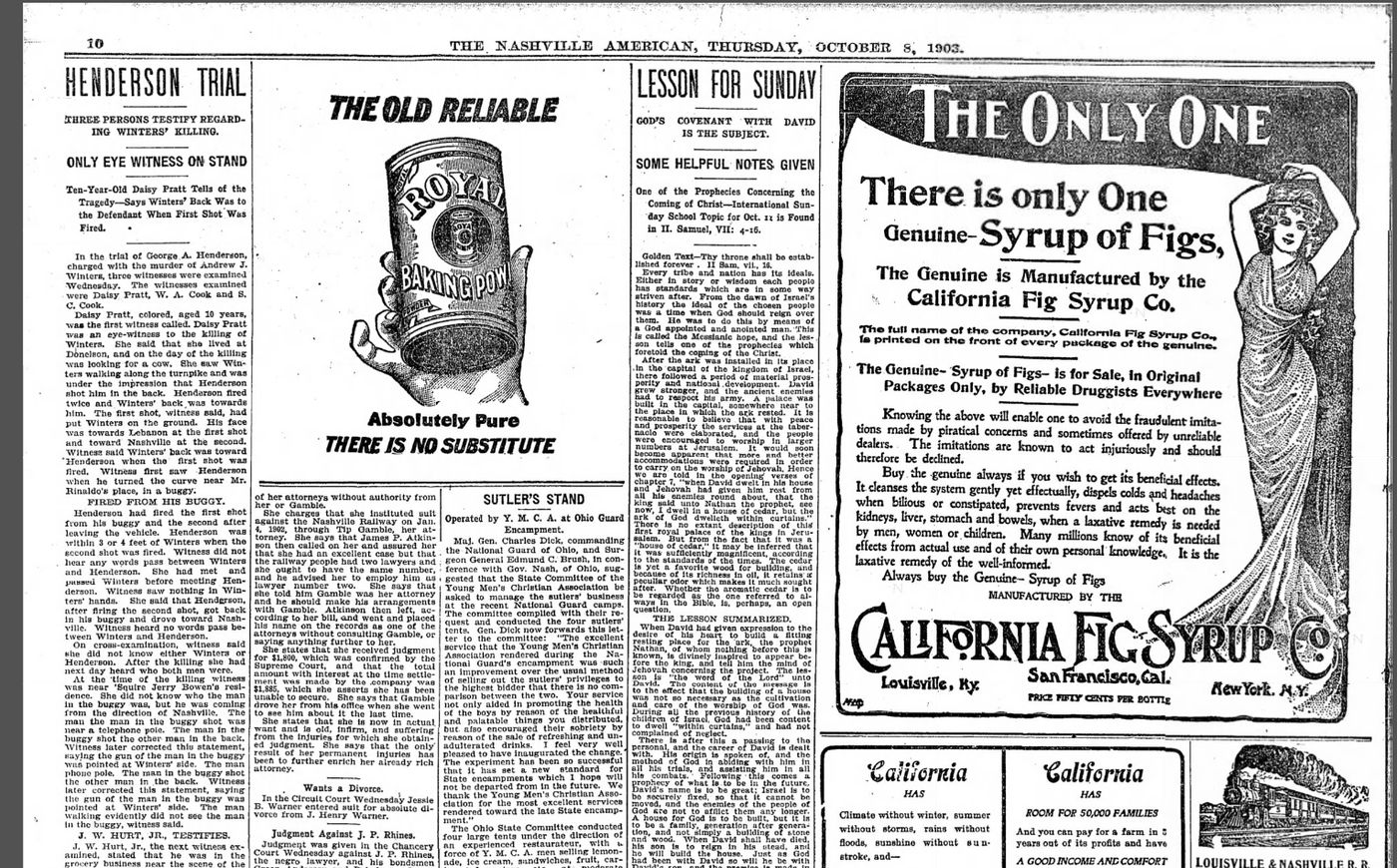
“In the Circuit Court Wednesday Jessie B. Warner entered suit for absolute divorce from J. Henry Warner.” She filed — and then she withdrew the petition. Whether she lost her nerve or her options, no record says. In 1903, the doors open to her were few.
The story turns
Here is where the story turns. Jessie’s first son was fathered outside her marriage — and James knew. He took her to Indiana to give birth, far from Nashville eyes, to disguise the child’s origins. In time Jessie had three sons. The youngest, born in June of 1911, was Felix Alonzo, or “Lonnie” — my grandfather.
In the year before Felix was born, Jessie often traveled out of the city to visit her father and stepmother, who had moved to a farm beyond Nashville. Katie — the half-sister, now grown and married to a man named William Bennett — had lived on that same farm. But that year, Katie and William left it and moved into Nashville, taking up residence near the Warner household.
Katie died at thirty, from complications of a premature birth. James Warner, harsh to the end, died of heart failure at fifty-four. Jessie, remarkably, remarried within the family — a cousin of her late husband, Percy Warner — and the story, as far as anyone knew, closed there.
August 23, 1904
Evansville, Indiana
Joseph Henry “Jody” is born
Ten months after the withdrawn petition, Jessie’s first son is born — not in Nashville, but across the Ohio River in Indiana, far from Nashville eyes. The family simply came home with a son.
August 30, 1907
Nashville
Langford Raymer “Bubbie” is born
Her second son carries her family in both names — Langford, her father’s middle name; Raymer, her own maiden name, stitched into the next generation.
June 1911
Nashville
Felix Alonzo “Lonnie” is born
The youngest — named for two of Jessie’s brothers, and “Lonnie” his whole life. My grandfather.
January 12, 1916
Nashville
The man the whole city knew
A patent-medicine advertorial puts James in print: “one of the biggest men in Nashville,” formerly 310 pounds in his stocking feet, the well-known grocer and meat market man. Even the ads knew the Warners.
January 28, 1916
Nashville
Social Jessie
Sixteen days after the Tanlac ad, the society column: a fancy-dress children’s party, streamers of pink and white, a Teddy bear contest — and there she is, helping the hostess, her three boys among the guests. She dressed her sons so beautifully she wouldn’t let them get dirty. They would do anything for her.
March 22, 1926
Nashville
James dies
At his home at 1004 Forest Avenue, at 10:18 on a Monday morning. Heart failure, at fifty-four. Requiem high mass at the Church of the Holy Name; interment at Mt. Olivet. The notice names his survivors: his wife, Jessie Raymer Warner, and his sons — all three of them, all Warners, whatever the years had kept to themselves.
February 6, 1929
Robertson County, Tennessee
She marries Percy Warner
A cousin of her late husband. She enters the marriage a Warner and leaves it a Warner — the name held fast around her for the rest of her life, whatever the chromosomes had to say.
About 1947
Miami, Florida
She leaves Nashville
After a lifetime in one city, Jessie moves south — near Joseph, her firstborn, the Indiana baby, now of Miami.
August 1958
Miami
A fourth great-grandchild is born
The obituary five months later will count four great-grandchildren. One of them is me.
February 21, 1959
Miami · buried in Nashville
Jessie dies
Aged 77. Three sons, a brother, six grandchildren, four great-grandchildren. Services and burial in Nashville, the city that knew her.
Finding answers — the reveal
For a hundred years, that was the record. Names, dates, a marriage, three sons, the ordinary architecture of a family tree.
Then a dozen of us spit into tubes.
The matches that shouldn’t have been there
When our DNA results came back, we found close cousin matches none of us could place — and, more telling, an absence. Not one of us matched the Warner line we descended from on paper. The butchers of Nashville, the three-hundred-pound patriarch, the whole expected branch: silent.
The matches pointed somewhere else. They pointed to William Bennett — Katie’s husband. My grandfather Felix had not been fathered by James Warner at all, but by the husband of Jessie’s own half-sister, living conveniently nearby in those years.
No one alive had known. Or almost no one. When I brought the findings to my aunt, she wasn’t shocked. Her grandmother, she confirmed, was known in the family to have had the affair that produced her first son — the Indiana baby. The later chapters were news, but the character of the story was not. The family had simply stopped telling it.
What I felt — and what I didn’t
Here is what surprised me most about the surprise: it didn’t feel like scandal. It felt like understanding.
Suddenly Jessie was not a name and a pair of dates. She was a motherless girl raised in a saloon, married at eighteen to a harsh man twice her size, filing for divorce and then losing her nerve — or her options. She was a woman in 1910 with almost no doors open to her, and she found one anyway. I don’t have to approve of every choice she made to recognize that I exist because of them. My grandfather, my father, me — we all walked out of that door she found.
And this is the part I keep returning to. When Jessie died in Miami in the winter of 1959, the newspaper counted her legacy: three sons, six grandchildren, four great-grandchildren. I was the fourth — six months old, too young to remember her. The obituary couldn’t have known that one of the four would grow up to open the envelope, follow the records back to Nashville, and find her secrets. Or that finding them would make me love her more, not less.
I didn’t lose a great-grandmother. I gained deeper understanding of the one I’d had all along and never knew.
Part Two: What a DNA surprise means — and how I handle them at Roots & Road →